
Squadron movements in September 1944
Detailing the main actions of the squadron during September 1944.
How to use the map: the + and - symbols zoom in and out to give an overview or a detailed impression of the terrain. By clicking and dragging on the map you can move around the landscape. Clicking on an icon brings up a text box explaining the significance of the date and location. The icons are placed to illustrate the events described in the document below.
The After Action Report text for September 1944, extracted from the original document.
Note: the original documents will be available for free download from this site in due course. The text has been extracted below, for easier reading and searchability. Note: I’m using AI agents, including BibCit, Google Gemini, ChatGPT and Microsoft Copilot for automated transcription processes and map creation, based on photographs of original documents, so there may be errors in spelling or misidentified numbers. Please report any errors via the site contact form.
Editor’s notes: this is where we can visually see the challenges faced by the squadron at this point in the journey east. For example, the delays in crossing the River Meuse between September 3 and 7. As the AAR shows, the squadron was forced to scout for crossings because all bridges from Charleville to Dinant had been blown.
Then the impact of reaching the edges of the Siegfried Line - Germany’s physical defensive wall. By September 15, the pace drops from 15+ miles a day to "dismounted patrols" in the Buchholz Forest. As you can see in the AAR, place names give way to individual coordinates. This is where they’re hitting the outer defenses of the ‘Westwall’.
The cost of this period is illustrated below where an ambush is reported that kills 3 of the men in the AAR entry for September 17/18.
Also note how often Bullingen, Rocherath, and Krinkelt appear in the AAR. These areas will become the "hot corner" of the Battle of the Bulge just three months later.
The liberation of Charleville, at the beginning of September, is detailed in a special feature here.
September 1944 After Action Report
24th Cavalry Reconnaissance Squadron (Mechanized)
LT. COLONEL F. H. GASTON, JR., COMMANDING
Period: 1 September 1944 to 30 September 1944, Inclusive
RESTRICTED
Headquarters
24TH CAV. RON. SQ. MECZ.
APO #230, U.S. Army
30 September 1944
After Action Reports
a. Original Unit: No Change
b. Changes in Organization: None (see Annex 1 for Attachments)
c. Strength:
Commissioned / Enlisted
1 Sept. 1944: 41 / 711
30 Sept. 1944: 38 / 674
d. Stations: See Annex 1
e. Marches: See Annex 1
f. Campaigns: Campaign of Western Europe
g. Battles: See Annex 1
h. Commanding Officer: See Annex 1
i. Losses in Action: See Annex 1
j. Citations: See Annex 1
k. Photographs: None
l. Enclosures: See journal and supporting documents
RESTRICTED
On the morning of the 1st of September, the Squadron continued to screen the line from LAON North to the cross road 5 kilometers North of MARLE with Troop A on the South, Troop B in the center, and Troop C on the North. Troop B succeeded in occupying the town of MARLE, the enemy having been driven West from that vicinity on the previous day. The Squadron CP and Troops F and E were in the vicinity of MONTIGNY. At 1130 Group directed that the Squadron, less Troop B, assemble by Troop in their present locations, prepared to move East on a new mission. Troop B continued to hold MARLE until relieved later in the day by the First Infantry Division. The new Squadron mission was to establish a counter-reconnaissance screen from AUBENTON North to ANY, then South through BOSSUS to RUMIGNY, thence Southeast to LIART, by establishing road blocks (see overlay) and patrolling between the blocks. The line was split at RUMIGNY and Troop A was given the North half of the line and Troop C the South half. The Squadron CP and Troops E and F moved to the vicinity of BRUNEHAMEL, arriving at 1630. At 1640 the relief of Troop B was completed at MARLE. Troop A with one platoon of Troop F attached moved East and contacted the enemy at RUMIGNY. Friendly Infantry units were still engaged with the enemy at AUBENTON, which prevented elements from A Troop from moving farther to the North. Meanwhile Troop C with one platoon of Troop F attached succeeded in establishing their screen from RUMIGNY South to LIART. One camouflaged enemy vehicle and a few dismounted men were contacted in LIART. At 1800 Company A of the 635 TD was attached to the Squadron. Two of the TD platoons were utilized immediately in establishing road blocks and were attached to Troops A and C. By 2210 Troop A had established their screen from RUMIGNY North to AUBENTON and had established contact with friendly Infantry which held the town at that time. Troop F was employed in blocking the roads in the vicinity of BRUNEHAMEL.
On September 2, the Squadron continued its screening mission. Troop A bypassed friendly Infantry to the East and at 1034 their forward elements had reached ANY and completed our screen. Troops A and B patrolled East of the screen and contacted small enemy detachments along the entire line. At 1410 the Squadron was directed to establish a strong road block at the cross road Southwest of ETEIGNIERES and push reconnaissance North to ROCROI and East to CHARLEVILLE. Troop B, which was at that time in Squadron reserve, was employed on this mission. At 1800, forward elements of Troop B reached the cross road Southwest of ETEIGNIERES and by 1830 this point was secured. Lt. Bloomfield's platoon pushed aggressively East toward CHARLEVILLE and at 2145 had arrived on the Western outskirts of the town. A large enemy force estimated to be about 1200 men with two medium tanks and light artillery was reported to be holding the town. The platoon remained in observation in that vicinity during the night. At 2300 Lt. Haverstick's platoon had reached the edge of ROCROI and reported no enemy in the vicinity. Troops A and C had meanwhile assembled in the vicinity of AUBENTON and LIART prepared to move East the following day.
On September 3, the Squadron's mission was to seize the high ground Northwest of CHARLEVILLE and the town of ROCROI and to reconnoiter for crossings over the MEUSE river between the two towns. At 0100 orders were issued to Troop C to proceed East at daylight and seize the high ground West of CHARLEVILLE. One platoon from Troop E, and one platoon from Company A, 635th TD Battalion were attached to Troop C for this mission. Troop A was directed to follow Troop C and assist them, if necessary, in securing the objective. Troop B, with one platoon of Troop E, one platoon of Troop F, and one platoon of TD's attached, was ordered to seize ROCROI. Lt. Bloomfield's platoon from Troop B was directed to remain in the vicinity of CHARLEVILLE until the arrival of Troop C. By 0930, Troops C and A had attained their objective. At 0940 Troop B reported that they had occupied the town of ROCROI. The Squadron CP moved from BRUNEHAMEL to ROCROI arriving at 1200 after travelling 32 miles. The remainder of Troop F and Company A of the 635 TD's were employed in blocking approaches to ROCROI. Troop B having been relieved at ROCROI moved East toward RENVIN and at 1220 arrived at the town and found all bridges over the river in that vicinity destroyed. Platoons from Troops B and A reconnoitered the river for bridges and fords between ROCROI and CHARLEVILLE but found no suitable crossings. At 2000 Troop B reported a partially destroyed railroad trestle in the vicinity of LAIFOUR which might be used as a foot bridge. They became involved in a fire fight with an estimated 80 dismounted enemy in the town of LAIFOUR. Friendly civilians reported approximately 200 enemy troops on the East side of the river opposite the bridge. Meanwhile, Troop C pushed patrols into the town of CHARLEVILLE. Four large explosions were heard just prior to the entrance of the patrols. Troop C occupied the town at 1300 and found all bridges over the MEUSE on the East side of CHARLEVILLE destroyed. Enemy movement on the East side of the river was detected and small arms fire was exchanged several times. At 2000, Troop A which was engaged in a heavy fire fight for a railroad bridge, which was still extant North of CHARLEVILLE, was withdrawn from the vicinity of CHARLEVILLE upon orders from Group and moved North to ROCROI. Troop B remained in the vicinity of RENVIN for the night, and Troop C continued to hold CHARLEVILLE.
On September 4, the Squadron less Troops B and C with their attachments, received the mission of moving North to PHILLIPVILLE and reconnoitering East, along the Northern boundary of the Group zone, toward DINANT. Troop B moved West and occupied ROCROI and Troop C continued to hold CHARLEVILLE; these towns were to be held until Troops B and C were relieved by elements of the V Corps. Troop A, with one platoon of Troop F attached, moved North at 0700 toward PHILLIPVILLE, Squadron CP moved North at 0715. At 0730, Squadron CP crossed the Belgian Border. At 0900 Troop A had reached PHILLIPVILLE and encountered heavy friendly traffic on the PHILLIPVILLE-DINANT highway. Troop A bypassed this traffic to the North and moved East on secondary roads to the vicinity of SOMMIERE. The Squadron Forward Echelon followed Troop A and at 1245 established a CP at FALAEN. Troop A continued to patrol East to the MEUSE River. They reported all bridges over the MEUSE in our sector destroyed, and received hostile artillery from the East side of the river. At 1920 elements of the V Corps relieved Troop B at ROCROI and Troop B moved North and bivouacked for the night in the vicinity of ROSEE. Relief of Troop C had not been accomplished and they continued to hold CHARLEVILLE.
On September 5, the Squadron remained in the same location and Troop A continued to reconnoiter the MEUSE River line for fords. The enemy continued to shell the West bank of the river and our supporting artillery replied with counterbattery fire. At 1130 relief of Troop C at CHARLEVILLE was accomplished and they moved North to the vicinity of ROSEE arriving there at 1500. At 1430 Troop B was detached from the Squadron and attached to VII Corps Headquarters, as a guard Troop.
On September 6, the Squadron remained in the same vicinity. Troop A continued to patrol to the river line. Engineers were working on a bridge in the vicinity of DINANT but hostile artillery and mortar fire harassed them almost continuously and progress on the bridge was very slow.
At 1000 on 7 September, the Squadron was alerted for movement, on thirty minutes notice, across the MEUSE River over the bridge at HASTIERE LAVAUX or the bridge at DINANT. The bridge at DINANT was still under construction. At 1200 the Squadron assembled in the vicinity of ANTHEE preparatory to crossing the river at DINANT. At 2100 the bridge at DINANT was completed and the entire Squadron, led by Troops A and C completed the crossing at 2357, and bivouacked for the night in the vicinity of CELLES.
On September 8, the Squadron reconnoitered to the East in the North half of the Group zone. The 4th Cav. Ren. Sq. was assigned the Southern half of the zone. The Northern boundary of the Group zone was from CINEY generally Northeast through AYWAILLE to SPA. The Southern boundary extended from ROCHEFORT generally East to VIELSALM. The ultimate Group objective was MALMEDY. Troop A, with one platoon of Troop E, and one platoon of Troop F attached, was given the Southern half of the Squadron zone; Troop C, with one platoon of Troop E, and one platoon of Troop F attached, was given the Northern half of the Squadron zone. The enemy situation at this time was fluid; the terrain was rolling and the streams ran generally North and South. For the above reasons, the boundaries between Squadrons and Troops were purposely not clearly defined so as to allow one Troop to side slip resistance by maneuvering around through an adjacent Troop's sector. Troops A and C moved East in their assigned zones at 0700. At 0740, Troop A contacted elements of the 4th Ren. Squadron at VERRE. Both Troops initially advanced rapidly, destroying or driving back small enemy detachments and pockets of resistance with their attached tank platoons. As the Squadron approached the OURTHE River, enemy resistance became more determined. Troop A lost two Armored Cars which were destroyed by Mark V tanks in the vicinity of WAILLET, but they succeeded in destroying 4 enemy half tracks and several cargo trucks in this encounter. The enemy tanks withdrew to the Northeast and Troop A continued its advance. The South platoon of Troop C commanded by Lt. Stewart was held up in the vicinity of NETTINNE by a road block situated in a defile and defended by an AT gun. Artillery and mortar fire was placed on the enemy position and the platoon bypassed this resistance to the North. Meanwhile the remainder of Troop C continued to push Northeast toward MAFFE. The Squadron CP moved Northeast from the vicinity of CELLES and bivouacked in the BOIS de L'ABINE after traveling 9.2 miles. By nightfall, Troops A and C were disposed generally along the North-South highway between MARCHE and MEAN.
On September 9, the Squadron mission was to continue reconnaissance to the Northeast in its assigned zone. Troops A and C pushed East to the OURTHE River and started reconnoitering the river for suitable crossings or fords. At 0820 Troop A reported the bridge at NOISEUX destroyed and hostile artillery fire began falling in the vicinity of the town. A Troop was directed to contain the enemy in that vicinity with Lt. Sauerman's platoon and continue reconnaissance of the river line to the North. Troops A and C during the course of the day reported all bridges between NOISEUX and COMBLAIN AU PONT destroyed. Accurate enemy artillery fire from the East side of the river was delivered against both Troops throughout the day. Troop A captured two prisoners who reported that the Germans were withdrawing to the line LIEGE - NAMUR to make a determined stand. At 1930 Troop C contacted elements of the 60th Infantry in the vicinity of COMBLAIN AU PONT. At 2000, a suitable ford was discovered at GRAND HAN. Troop A accordingly assembled in the vicinity of SOMME LEUSE and Troop C assembled in the vicinity of OUFFET preparatory to crossing at that point on the following day. The Squadron CP moved Northeast to the vicinity of OCQUIER and bivouacked in that locality for the night. The 4th Cav. Squadron was withdrawn from their zone this date, by the CO, 4th Cavalry Group, and sent North and East toward MALMEDY. Our Squadron's mission was to continue East in generally the same zone.
On September 10, the Squadron continued its reconnaissance to the Northeast in the assigned zone. The Group Commander sent one Company of attached tanks across the ford at GRAND HAN at 0800. They contacted and drove out small enemy detachments on the East side of the ford. At 1050 Troop A had crossed at the ford and Troop C followed Troop A at 1130. Both Troops were directed to push rapidly East as an enemy withdrawal along the entire front was apparent. At 1400 Troop C had pushed Northeast to the vicinity of WERBOMONT, and Troop A had pushed East to the vicinity of IREZEE. The Squadron CP crossed the ford and bivouacked temporarily at BARVAUX. Troop C attacked WERBOMONT at 1430 and succeeded in driving a superior enemy force East from the town. One truck and eight Machine Guns were destroyed, 8 enemy were killed, and 12 prisoners were captured in this action. Meanwhile, Troop A was pushing rapidly East and at 1630 had reached GRANDMENIL. Troop C contacted the 60th Infantry in the vicinity of WERBOMONT and Troop A contacted the 12th Infantry in the vicinity of MALEMPRE. The Squadron CP moved to the vicinity of GRANDMENIL arriving at 1700, distance traveled 14.6 miles. The Squadron took a total of 17 prisoners of war this date.
On September 11, the Squadron continued reconnaissance to the East in the assigned zone. Troop C pushed East from WERBOMONT through BASSE BODEUX to the LAMBLEVE River and moved South along the river reconnoitering for a suitable crossing. At PETIT HALLEUX they found the bridge blown and covered by hostile AT fire. Friendly artillery laid a concentration on the enemy at that point but were unable to drive them out. Meanwhile Troop A pushed East on secondary roads to the vicinity of VIELSALM and found the bridge blown at that point. Elements of the 38th Ren. Squadron were contacted at VIELSALM. Troop A sent patrols North along the river to PETIT HALLEUX but they were unable to find a suitable crossing or ford. Many strong points were situated along the bank of the river on the East side in our zone and they were supported by artillery. Friendly Infantry succeeded in forcing a bridgehead at SALMCHATEAU which caused the enemy to withdraw from VIELSALM. Troop A discovered and effected a crossing South of VIELSALM at 2118 and occupied the town during the night. The Squadron CP moved East and bivouaced for the night in the vicinity of LIERNEUX. The Squadron captured 19 prisoners of war this date. The enveloping maneuver of the 4th Squadron was successful and they entered and took MALMEDY from the North this date.
On September 12, the Squadron continued reconnaissance to the East. At 0830, the entire Squadron had crossed the LAMBLEVE River in the vicinity of VIELSALM. Troop A moved East from the crossing and Troop C moved North along the River toward STAVELOT where they contacted elements of the 4th Cav. Squadron at 1110. The bridge over the LAMBLEVE River at that location was found intact. At 1130, Troop A had entered the town of RECHT and found it unoccupied by the enemy; the civilian attitude appeared unfriendly, however. At 1135 the Squadron was directed to be prepared to continue East and sieze the road net leading East from the towns of DIEDENBURG, BULLINGEN, and RUNNINGEN. At 1200, A Troop contacted enemy vehicles East of RECHT, opened fire on them, and caused them to withdraw to the East. At 1213, Troop C captured 15 prisoners 3 miles East of STAVELOT. At 1410, a German map captured by Troop A indicated enemy positions at NEIDER-SAMELS, BORN, DEIDENBURG, and BULLINGEN, with a hostile Battalion CP at MEDELL. Our Air Corps was bombing and strafing in the vicinity of BORN at 1515. At 2000, Troop C was in the vicinity of ONDEVAL and Troop A was 2 kilometers West of DEIDENBURG. Troop C was given EIBERTINGEN, and Troop A BULLINGEN as objectives for the following day. Squadron CP moved to the vicinity of RECHT and bivouaced there for the night. Nineteen prisoners of War were taken this date.
The Squadron continued to reconnoiter to the East on September 13. Troop A was held up by 3 undefended road blocks in the vicinity of MIRFALD which they had to bypass to the North. Troop C found EIBERTINGEN unoccupied and entered the town at 1000. At 1015, one platoon of TD's was detached from the Squadron and sent to Group Headquarters. They were replaced by 1 platoon of the 297th Engineer Battalion. At 1145 Troop A had secured BULLINGEN. They were directed to hold the town and push reconnaissance to WIRTZFIELD, MURRINGEN, and ROCKERATH. Troop C was instructed to bypass Troop A to the South and proceed East toward the Seigfried line. At 1345 Troop A entered WIRTZFIELD, and contacted elements of the 4th Cavalry Squadron. At 1600 Troop C reported that they were held up by a hostile road block 2 kilometers East of BULLINGEN. They bypassed this road block to the South and encountered hostile enemy fire coming from the woods to the East. Lt. Allen's platoon was pinned down temporarily by hostile fire delivered by several Mark V tanks and self propelled guns. Troop C's attached assault guns registered on the woods where the enemy was located and the attached TD platoon was disposed to prevent the hostile enemy tanks from breaking through. C Troop established their CP at MURRINGEN and the high ground to the East of the town was organized for night defense. The Squadron CP moved East and bivouaced for the night in the woods in the vicinity of HEPSCHEID.
On September 14, the Squadrons mission was continued reconnaissance East to the Seigfried line. Troop C pushed Southeast on the main Highway from BULLINGEN and contacted enemy patrols in the BUCHCOLZ FOREST at 0930. At 1530 Group Headquarters reported that elements of the 4th Cav. Squadron had been driven out of ROCHERATH by enemy tanks. Troop A secured the roads South of ROCHERATH with their attached TD platoon and an artillery concentration was laid on the town. At 1830 A Troop attacked ROCHERATH and drove the enemy Northeast from the town. One hostile ammunition truck was destroyed and six prisoners of war were taken in this action. A Troop occupied the town for the night, defending it from the high ground to the North and East. The Squadron CP moved to BULLINGEN.
On 15th September the Squadron mission remained the same. Visibility was extremely poor and the dense fog hindered the progress of patrols. Dismounted patrols were used almost entirely as the BUCHHOLZ forest is extremely dense, and the few trails leading through it were impassible to our vehicles. Both Troops succeeded in working dismounted patrols to the highway on the German border just West of UDENBRETH and HOLLERATH. This highway was strewn with felled trees and anti tank mines. A few suspected pill box locations were reported and anti tank obstacles were spotted East of the highway. Numerous enemy patrols were contacted in this forest which caused our patrols to proceed with extreme caution.
On September 16 our mission remained the same. Patrolling continued in spite of dense fog which greatly impeded visibility. Troop C contacted an estimated platoon of enemy Infantry and one AT gun at the cross road at 009989. An artillery concentration was placed on this location causing the enemy to withdraw. At 1800 Troop C moved East and occupied this cross road. Patrols from Troop A returned with a complete report on the extent of the road blocks on the North South highway. Another platoon from Company A of the 297th Engineers was attached to the Squadron this date. This platoon cleared all obstacles from the road running Southeast from BULLINGEN.
On September 17, Troop C was given the mission of moving North along the highway toward HOLLERATH. Two Engineer platoons under Lt's. Persons and Duffy worked North clearing the abatis from the highway. Lt. Stewart's platoon from Troop C preceded the engineers to provide protection for them. Troop A sent dismounted patrols East through the forest to try to contact Troop C as they worked North. At 1445 the enemy laid an artillery concentration on the Engineers and they were forced to withdraw. They succeeded in clearing three separate road blocks consisting of abatis 200 to 300 yards long at each block, and advanced 3 kilometers North of the cross road. Troop C withdrew to the cross road at 009989 and remained there during the night.
During the night of September 17–18, a German patrol attacked Troop C at the cross road and damaged one bantam with a stick grenade. Troop C killed one member of the patrol and wounded several others, causing them to withdraw to the East. Work was resumed by the Engineers on the North South highway at 0800. Troop A again sent patrols East through the forest. The position of Troop C and the Engineers which were working on the highway was extremely unstable as strong enemy patrols were able to work through the woods behind them and harass them by fire. They were also subject to observed artillery and mortar concentrations. At 1635 following a heavy artillery concentration, an estimated enemy Infantry Company attacked the Troop C platoon guarding the Engineers and forced them to withdraw to the cross road. An enemy patrol ambushed them on their return and destroyed one ¾ ton truck and killed three of our men. A patrol from Troop A opened fire on an enemy patrol in the vicinity of the cross road at 005052, killing one and capturing two prisoners. Artillery concentrations were laid on enemy positions during the night.
On the 19th of September, the Squadron was directed to hold in their sector. The high ground to the East of ROCHERATH and MURRINGEN was organized for defense as it afforded the Troops good fields of fire. Troops A and C each had one platoon of Troop F, one platoon of Troop E, one platoon of TD's, and one platoon of Engineers attached. All avenues of approach were covered by anti tank fire, and the assault guns were disposed to support the entire Troop front. The Engineers laid an intricate net of booby traps at the edge of the woods and also within the woods across likely avenues of enemy approach. Anti tank mine fields were laid on all roads approaching the Troop positions. Troop A of the 4th Ren. Squadron, Captain Goddard commanding, was attached to the Squadron this date. They continued to hold their former position astride the highway running North from ROCHERATH, and continued their daily patrols through the forest to the North.
From September 20 to September 30, the Squadron continued to hold in its sector. The attached overlay will show our defensive positions in detail. Daily patrols were sent East from MURRINGEN and ROCHERATH to the North South highway to reconnoiter the German border and to prevent hostile patrols from observing our positions. Troop A of the 4th Cav. Squadron continued to send daily patrols to the North. A tank platoon from Troop F made a daily patrol from BULLINGEN, South through HUININGEN to HANSFELD. The Squadron was supported by the 87th Armored FA Battalion which was attached to 4th Cavalry Group, and located West of ROCHERATH. On September 22, Troop B reverted to Squadron control and relieved Troop C at MURRINGEN, which was detached from the Squadron and attached to the VII Corps for guard duty. During this period Captain Fornbeck the Squadron motor officer, had an opportunity to perform 6000 mile maintenance on the majority of the Squadron vehicles. The rear echelon was moved to MALMEDY and the Mechanics had shelter and other facilities which aided greatly in accomplishing our much needed maintenance. Enemy activity during the period consisted of active patrolling to our line, and occasional artillery barrages on ROCHERATH and MURRINGEN.
Officers Wounded in Action
2nd Lt. Joseph R. Stewart, Jr., 01018303, Troop C, 24th Cav Rcn Sq, Mech, in the vicinity of MURRINGEN, BELGIUM, 17 September 1944.
1st Lt. Kiffin W. Browning, 0378924, Co. F, 24th Cav Rcn Sq, Mech, in the vicinity of BULLINGEN, BELGIUM, 25 September 1944.
Enlisted Men Killed in Action
Tec 4 Iver O. Olsen, 6933625, Troop B, 6 September 1944, vicinity of FOSSES, BELGIUM.
Tec 5 William H. Sterling, 36414419, Troop C, 8 September 1944, vicinity of CELLES, FRANCE.
Pvt John BMI Tyshur, Jr., 55402151, Troop C, 8 September 1944, vicinity of CELLES, FRANCE.
Pvt Robert L. Van Dereau, 35765436, Troop C, 8 September 1944, vicinity of CELLES, FRANCE.
Pvt Benjamin F. Berrier, 54778699, Troop C, 10 September 1944, vicinity of JENNERET, BELGIUM.
Sgt Joseph L. Weaver, 17018341, Troop C, 18 September 1944, vicinity of MURRINGEN, BELGIUM.
Pvt Clifford F. Thompson, 32735689, Troop C, 18 September 1944, vicinity of MURRINGEN, BELGIUM.
Pvt Walter F. Couch, 6208919, Troop B, 19 September 1944, vicinity of KORNELIMUNSTER, GERMANY.
Pvt Raymond L. Kohler, 52735639, Troop B, 19 September 1944, vicinity of KORNELIMUNSTER, GERMANY.
Tec 5 Lloyd V. Syversen, 87081152, Co. F, 25 September 1944, vicinity of BULLINGEN, BELGIUM.
Enlisted Men Wounded in Action
Pvt Sell H. McDaniel, 34598958, Troop A, 8 September 1944, vicinity of WAILLET, BELGIUM.
Pvt J. P. Thrower, 34026381, Troop C, 8 September 1944, vicinity of CELLES, FRANCE.
Sgt Herman A. Schieber, 57023501, Troop C, 8 September 1944, vicinity of CELLES, FRANCE.
Pvt William M. Jones, 57583985, Troop C, 8 September 1944, vicinity of CELLES, FRANCE.
Pvt Clarence F. Bellinger, 16151698, Troop C, 10 September 1944, vicinity of JENNERET, BELGIUM.
Pvt Lee NMI Danylak, 13174417, Troop C, 10 September 1944, vicinity of JENNERET, BELGIUM.
Tec 5 Franklin W. Bascom, 37081111, Troop C, 13 September 1944, vicinity of PONT, BELGIUM.
Pvt Richard S. Kopaczewski, 36280627, Troop C, 15 September 1944, vicinity of PONT, BELGIUM.
Pvt Max E. McConnell, 35615371, Troop C, 15 September 1944, vicinity of PONT, BELGIUM.
Pfc Andrew NMI Vander Vliet, 37078422, Troop C, 13 September 1944, vicinity of PONT, BELGIUM.
S/Sgt Albert NMI Alberda, 6864120, Troop C, 17 September 1944, vicinity of MURRINGEN, BELGIUM.
Pfc Emerson H. Tate, 16149746, Troop C, 18 September 1944, vicinity of MURRINGEN, BELGIUM.
Pvt William R. Bunting, 34599439, Troop B, 19 September 1944, vicinity of KORNELIMUNSTER, GERMANY.
Tec 5 Joseph A. Kurek, 31040344, Troop C, 20 September 1944, vicinity of MURRINGEN, BELGIUM.
Tec 5 Leslie W. Cook, 37078670, Troop E, 20 September 1944, vicinity of BULLINGEN, BELGIUM.
Tec 5 Albert R. Schanzenbach, 57025857, Troop A, 21 September 1944, vicinity of ROCHERATH, BELGIUM.
Pvt John J. Triano, 42041749, Troop A, 21 September 1944, vicinity of ROCHERATH, BELGIUM.
Sgt John C. Brummer, 39160759, Troop A, 21 September 1944, vicinity of ROCHERATH, BELGIUM.
Cpl Porter H. Bowman, 6998892, Troop A, 25 September 1944, vicinity of ROCHERATH, BELGIUM.
Sgt Rodney R. Flanders, 17018031, Troop A, 25 September 1944, vicinity of ROCHERATH, BELGIUM.
Cpl Coy R. Castleberry, 34208835, Troop E, 25 September 1944, vicinity of BULLINGEN, BELGIUM.
Cpl Melvin F. Kinsie, 16059114, Troop B, 26 September 1944, vicinity of MURRINGEN, BELGIUM.
Enlisted Men Wounded in Action, Remained on Duty
Cpl Thomas NMI Masi, 15324867, Troop A, 3 September 1944, vicinity of ROCROI, FRANCE. The Purple Heart was awarded.
Pfc Oscar L. Cravens, 39902752, Troop A, 4 September 1944, vicinity of HAUT-LE-WASTIA, BELGIUM.
Pfc James R. Rose, 39288318, Troop C, 10 September 1944, vicinity of JENNERET, BELGIUM.
Pfc James R. Hamrick, 15090240, Troop C, 10 September 1944, vicinity of JENNERET, BELGIUM.
Pfc Durell M. Webster, 33075956, Troop A, 11 September 1944, vicinity of BURG, BELGIUM. The Purple Heart was awarded.
Pvt Charles NMI Mayer, 52273263, Troop A, 11 September 1944, vicinity of BURG, BELGIUM. The Purple Heart was awarded.
Sgt Alfred G. Stewart, 37081238, Co. F, 25 September 1944, vicinity of BULLINGEN, BELGIUM. The Purple Heart was awarded.
Tec 4 Valdese W. Wilson, 17005623, Co. F, 25 September 1944, vicinity of BULLINGEN, BELGIUM. The Purple Heart was awarded.
Pvt William H. Tedd, 15522449, Troop B, 26 September 1944, vicinity of MURRINGEN, BELGIUM. The Purple Heart was awarded.
Replacements Received
Officers:
Captain Rutherford D. Neal, MD, 0462432, 4 September 44.
1st Lt. Albert C. Sauerman, 01030713, 4 September 44.
Enlisted Men:
S/Sgt Kenneth D. Larsen, 6864215, 13 September 44.
S/Sgt William M. Nell, 37039301, 15 September 44.
Sgt Edward S. Reilly, 31035470, 13 September 44.
Tec 4 Frank F. Vide, 32156480, 15 September 44.
Pfc Emerson H. Tate, 16149746, 13 September 44.
Sgt Raymond B. Loveless, 6956820, 14 September 44.
Tec 4 Clarence W. Deering, 37024123, 15 September 44.
Sgt Sandy NMI Speirs, 57039409, 15 September 44.
Tec 5 Robert F. Gerspach, 16150044, 15 September 44.
Pfc Steve R. Pajka, 35065666, 16 September 44.
Cpl Marion D. DeShon, 37512838, 19 September 44.
Pvt Burl F. Hanlin, 35395923, 27 September 44.
Pvt Harold E. Glasgow, 36479314, 27 September 44.
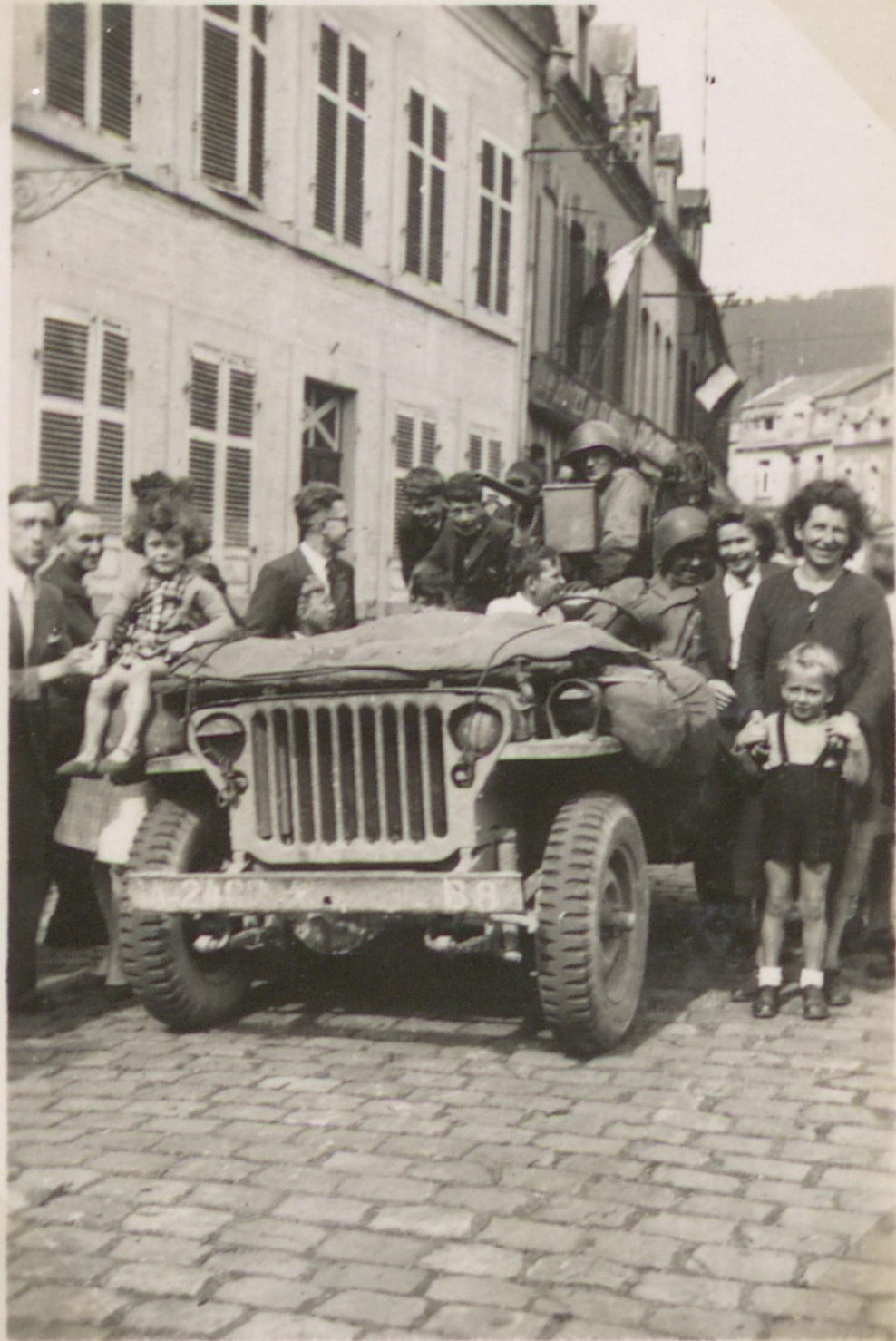
A Jeep of Reconnaissance Troop B passes through Revin, 30 km north of Charleville-Mézières. Photographic credit: The Liberation of the Ardennes in pictures, Archives départementales des Ardennes. See more pictures of the squadron in this area on the page detailing the liberation of Charleville.