
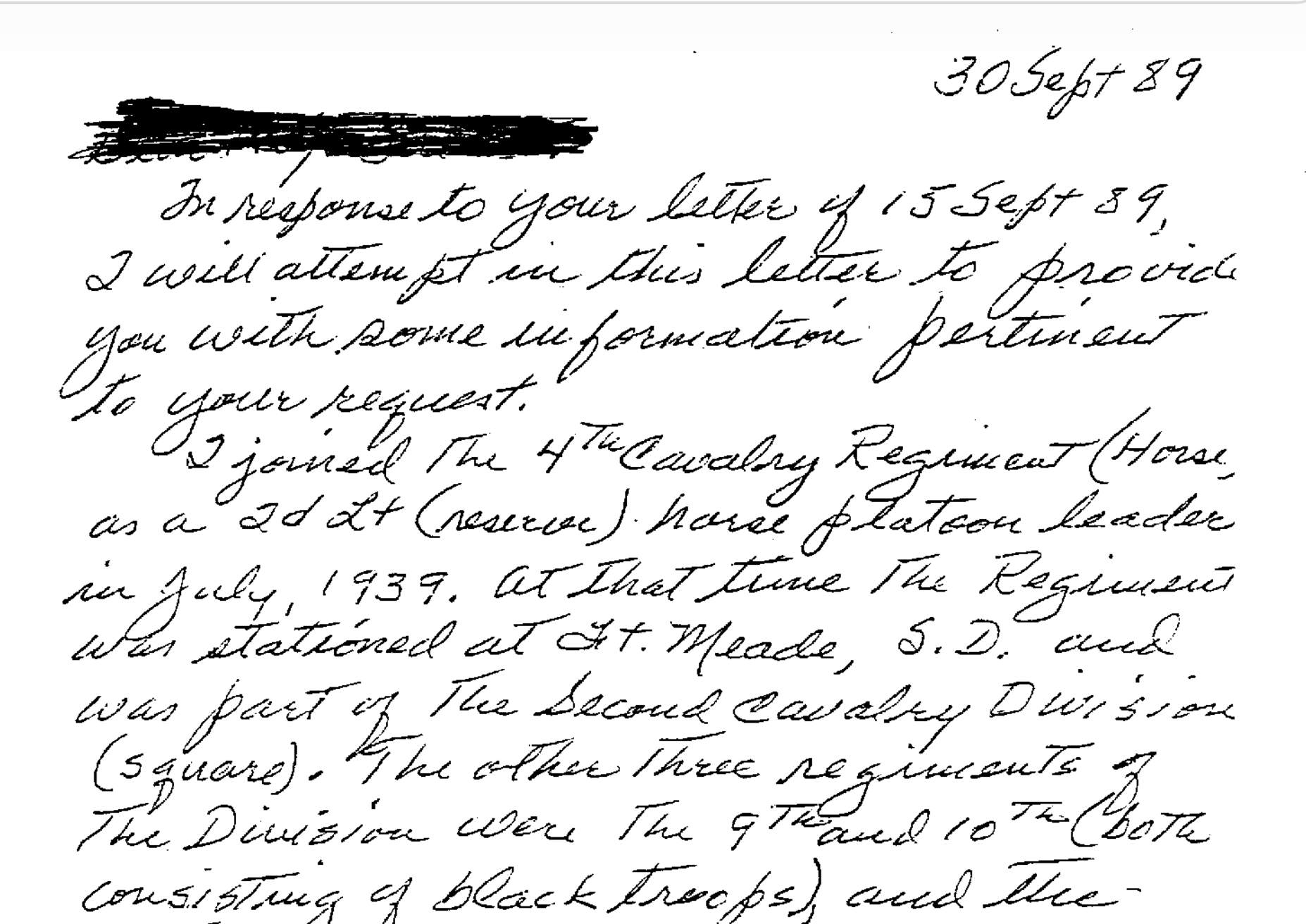
Bob Clark, son of squadron Executive Officer Major Harry Ainsworth Clark Jr, has shared this brief memoir of the 4th Cavalry Group’s formation and subsequent service. Characteristically there is no mention of his status as the recipient of a Silver Star. The letter was written in 1989 in response to a request for assistance with preparation for a ‘staff ride’ to commemorate the regiment.
Maj. Harry A. Clark Jr (O-375139) was the kind of senior officer who opted to fight side-by-side with the men, whether or not immediate duties demanded it, as evidenced by his Silver Star citation. A complete memorial page for Harry will be created for the site in due course.
This letter is invaluable as a primary source account of the squadron’s formation.
What follows is an AI transcript of the letter. As the original was handwritten and then copied, minor transcription errors may be present.
Page 1
30 Sept 89
[crossed out / illegible heading]
In response to your letter of 15 Sept 89, I will attempt in this letter to provide you with some information pertinent to your request.
I joined the 4th Cavalry Regiment (Horse) as a 2d Lt (reserve), horse platoon leader in July, 1939. At that time the Regiment was stationed at Ft. Meade, S.D. and was part of the Second Cavalry Division (square). The other three regiments of the Division were the 9th and 10th (both consisting of black troops) and the 14th — all four of the Regiments were horse Cavalry and were located at Ft Riley, West Point, Desmoines, Ia well as Ft. Meade.
The Regimental Commanders from the time I joined in 1939 until my departure in March, 1945 were:
Col Robert C. Rodgers 1939-40, later BG — deceased
Col John B. Coulter 1940-41, later LTG — deceased
Col Howell M. Estes 1941 — deceased
Col Joseph M. Tully 1942-44, later BG — deceased
Col John C. MacDonald 1944-45, later MG — deceased
Page 2
The Regiment participated in maneuvers in and around Ft. Jackson, Ark. (an old WW I cantonment area) near Little Rock, in the winter and spring of 1939-40. While we were in Arkansas we learned that the Regiment was to be converted to a Horse-Mechanized Regiment. This was done after our return to Ft. Meade in the summer of 1940 — the 1st Squadron remaining horse, and the 2d Sqdn becoming mechanized.
In Aug-Sept, 1940 the regiment participated in Maneuvers in Minnesota. In winter of 1940, in an attempt to improve mobility, the 1st (horse) Squadron was converted in 1941 to a more mobile configuration by providing us with semi-trailers pulled by trucks. One truck-semitrailer rig would accommodate 1 horse squad (eight horses with one attendant in the trailer and one soldier assistant truck driver). The rest of the squad personnel were transported by other trucks.
We maneuvered in the 1941 Louisiana maneuvers in this arrangement and learned that the truck-trailer arrangement was relatively mobile for extended highway distances, but was otherwise complicated, being poor for cross country work and highly visible and vulnerable.
Page 3
In 1942 we learned that the Regiment was to be converted completely to a mechanized organization. We went to Omaha, Nebraska in April 1942 to participate in an Army Day Parade and, on returning to Ft. Meade, we stopped at Ft. Robinson, Nebraska (an Army remount station) and turned in all of our horses (a sad day for most mounted troopers).
In January, 1943, we were ordered to the Desert Training Center in California and the Regiment (now completely mechanized) moved from Ft Meade to Cal by troop train. We spent about 7 months maneuvering in Cal and in July, 1943, were transferred for staging to Camp Maxey, Oklahoma Texas (near Paris). In late Nov. 1943 we moved by train to Camp Shanks, N.Y. (a port of embarkation) and in early December sailed on a British ship to England landing at Bristol in mid-December after about a 12 day sea voyage.
In England our designation was changed to the 4th Cavalry Group consisting of a Headquarters and two reconnaissance squadrons — the 4th and the 24th. We were
Page 4
billeted in about 3 locations near Chichester, England, on the South coast and conducted training in that general area until “D” day (6 June 44). We were named the Corps Reconnaissance Group for the VII Corps, First Army. The Corps was at that time commanded by LTG J. Lawton Collins, frequently referred to as “Lightning Joe,” and later the Army Chief of Staff. About 2 weeks before “D” Day one of our reconnaissance Troops from the 24th Squadron and another Troop from the 4th Squadron were moved from their locations for training for a secret “D” day mission.
Under cover of darkness on the night of 5-6 June these 2 Troops landed by rubber boats on the channel Iles de Marcouf — 2 small Islands near the coast of the Normandy peninsular. Their mission was to seize these islands to reduce any enemy threat to the landings at Utah Beach. These two 4th Cavalry troops were the first ground troops to land in enemy territory in the Normandy invasion. The Islands were successfully secured shortly after midnight and although they were not enemy occupied, several 4th Cav soldiers sustained wounds from booby traps.
Page 5
Under the able leadership of Col J. M. Tully, the 4th Cav Group landed on D+9 (15 June 44) at Utah Beach. The Group participated in the assault and reduction of Cherbourg which provided a key port for allied forces in Europe.
Near the end of June and in early July, 1944, the group participated in the assault and breakout of St. Lo and thereafter the group was supplemented by a series of units to create a reconnaissance Task Force — These attachments included:
a light tank battalion
a tank destroyer battalion
an armored artillery battalion (105 How SP)
Engineer and signal detachments
In the above configuration the reinforced group moved rapidly across France and Belgium to the Siegfried Line in eastern Belgium. This consumed the time from July to October.
I was ambushed and wounded while riding in a jeep on 19 October, near Monschau, Germany, and was evacuated and hospitalized in England until Feb, 1945. At that time the Group was located in reserve in Belgium. In early March
Page 6
the group moved to Aachen, Germany and prepared for an assault across the Roer River. Col Tully was transferred to the 90th Inf Div and assumed the position of Asst. Div. Commander in Dec 44. Col John C. MacDonald assumed command of the 4th Group in December and led it through the rest of the conflict until the war ended in May, 1945.
I can’t provide much information beyond March, 1945 as I was returned to the U.S. to attend C&GSC at Ft Leavenworth. After hostilities ceased the 4th Cav Group participated as part of the Constabulary in occupation of Germany.
I have no suggestions for your “staff ride” as I don’t know what it will entail.
It is widely written that an adult in this general time-frame will never forget where he was when Japan attacked Pearl Harbor (7 Dec 41) which is certainly true in my case. At that time we still had our horses in the 1st Squadron and that morning a large group of officers were riding around the Ft Meade countryside on an event we called a hunt-breakfast. After the riding terminated we assembled at the Officers’ Club for drinks, preparatory to
Page 7
breakfast. It was at that time that we heard over the radio from National media, that the Japs had attacked Pearl Harbor. Needless to say, it had a sobering effect on our festivities.
I’m not sure this information is what you want. If I can provide more detail in any particular area don’t hesitate to write again.
I might clarify my situation more by stating that in early 1946 I was integrated into the Regular Army as an Infantry officer. I subsequently served as a Bn. Commander in the Second Infantry Division during the Korean conflict and remained in the Infantry until I retired with 31 years service.
Sincerely,
H. A. Clark Jr
Col, US Army (Retired)
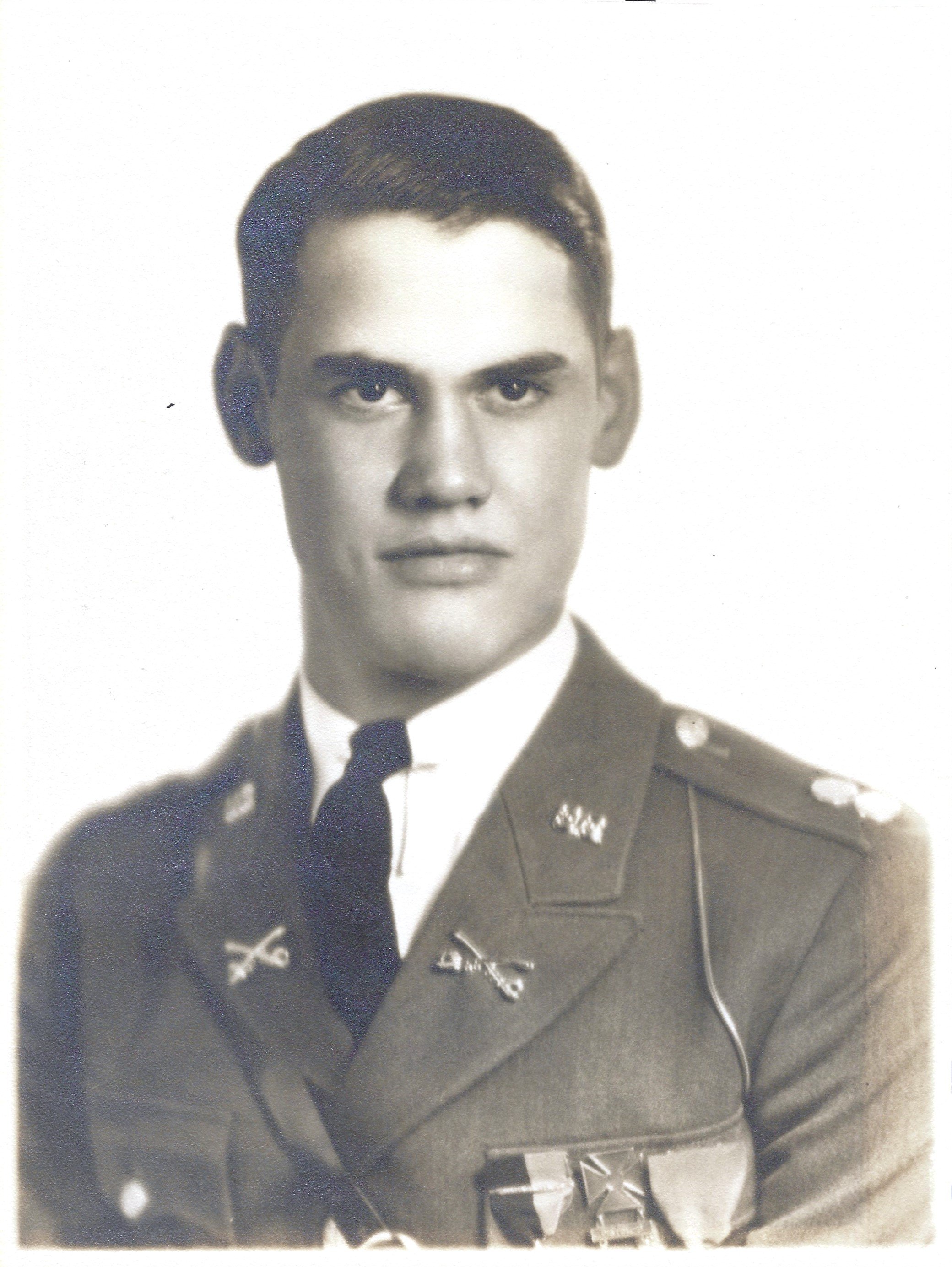
Harry A. Clark Jr’s NMMI class photograph